
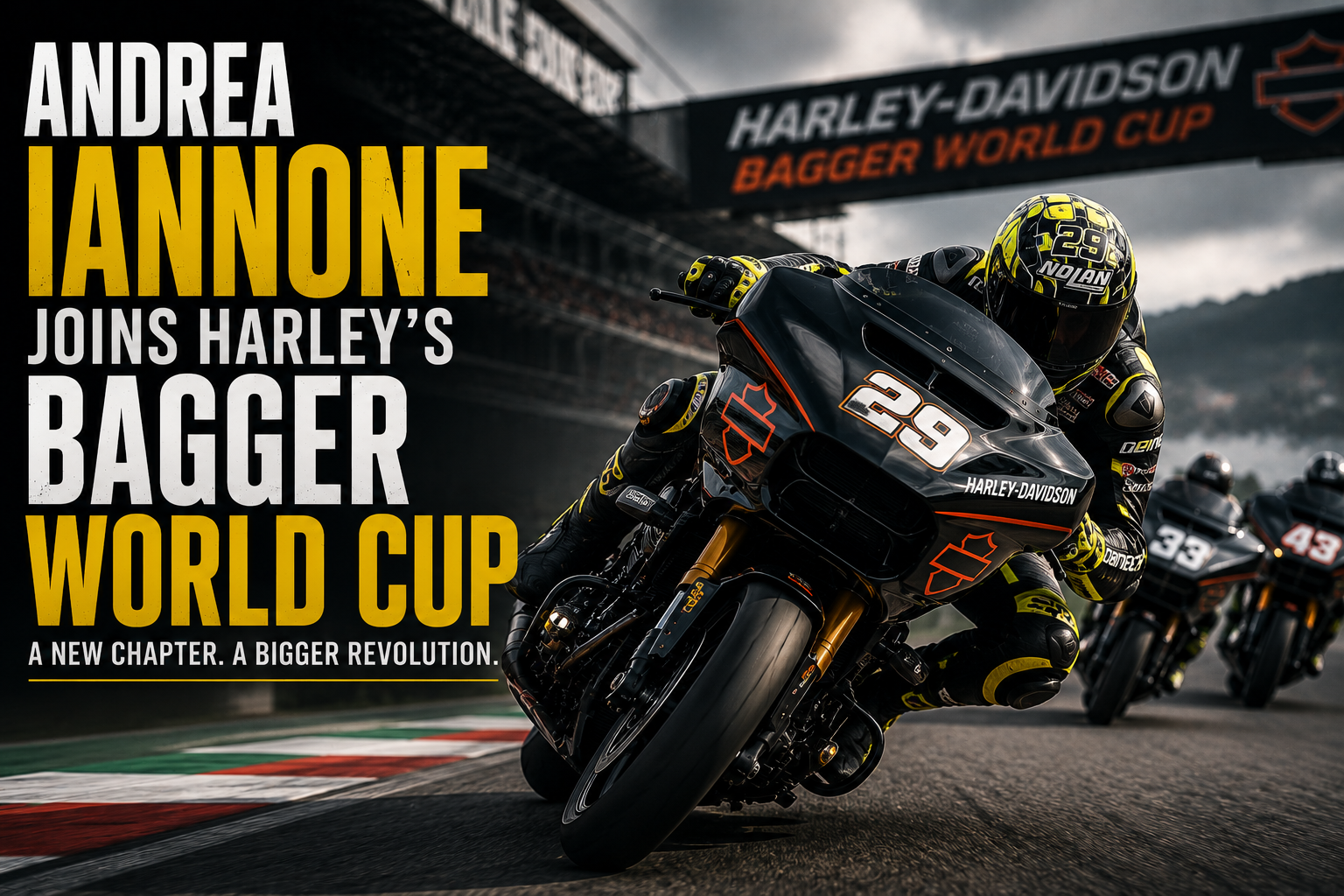
From MotoGP to Harley-Davidson Baggers
On paper, the idea still sounds unusual.
A former premier-class MotoGP rider competing on race-prepared Harley-Davidson baggers would have seemed almost impossible a decade ago.
For years, baggers were associated with:
Highway touring
Comfort and cruising
Traditional American motorcycle culture
Not racing.
Certainly not professional-level racing connected to major international events.
But over the last few years, bagger racing has evolved from a niche curiosity into something much larger — and much more serious.
Why This Story Matters
Andrea Iannone is not just another rider entering a race series.
He represents elite-level motorcycle competition.
His move into the Bagger World Cup instantly changes how many riders and fans perceive the category.
Because once professional racers begin taking something seriously, the wider motorcycle world tends to follow.
That’s exactly what appears to be happening here.
Harley-Davidson’s Performance Shift
This also aligns perfectly with Harley-Davidson’s broader transformation.
The company has spent years trying to modernize its image and attract younger riders, moving beyond the perception that Harley only builds heavyweight touring motorcycles for an aging audience.
Recent efforts have included:
Performance-oriented models
Racing involvement
More aggressive styling
Greater focus on accessibility and modern riding culture
Bagger racing fits directly into that strategy.
And importantly, it’s working.
The Unexpected Rise of Bagger Racing
Part of the appeal is simply the spectacle.
These motorcycles are:
Huge
Loud
Heavy
Visually aggressive
Watching them lean deep into corners and battle on racetracks creates a kind of controlled chaos that traditional motorcycle racing often lacks.
But there’s also something more authentic about it.
Unlike highly refined prototype racing machines, baggers still feel connected to real-world motorcycles — bikes people actually recognize and ride.
That connection matters.
A New Kind of Performance Culture
For decades, performance motorcycling was dominated by sportbike culture.
Lightweight machines, aerodynamic bodywork, and maximum speed defined what “performance” meant.
Bagger racing challenges that idea completely.
It replaces surgical precision with raw presence.
And strangely enough, that may be exactly why people are paying attention.
Because modern motorcycle culture is no longer as rigid as it once was.
Today’s riders move between:
Performance riding
Custom culture
Urban riding scenes
Lifestyle-focused motorcycling
The lines are blurring.
Motorcycle Culture Is Becoming Less Tribal
This is perhaps the biggest shift of all.
For years, motorcycle communities were heavily segmented:
Cruiser riders stayed with cruisers
Sportbike riders stayed with sportbikes
Touring culture stayed separate from racing culture
That separation is slowly disappearing.
Social media, customization culture, and evolving rider demographics are creating a more fluid motorcycle world — one where riders care less about category loyalty and more about identity, aesthetics, and experience.
Bagger racing sits directly in the middle of that evolution.
Why Younger Riders Are Paying Attention
One of Harley-Davidson’s biggest challenges has been attracting younger riders.
Traditional cruiser culture often felt disconnected from modern riding trends, especially among younger urban audiences.
Bagger racing changes the conversation.
Suddenly Harley-Davidson is associated with:
Competition
Aggressive riding
Modern performance culture
Social-media-friendly visuals
That shift matters more than lap times.
More Than a Racing Series
What makes this particularly interesting is that bagger racing doesn’t feel overly corporate — at least not yet.
There’s still an element of unpredictability and personality that modern motorsport sometimes lacks.
The bikes look imperfect.
The riding looks physical.
The racing feels dramatic.
And in an era where many forms of motorsport are becoming increasingly polished and data-driven, that rawness stands out.
Is This the Future?
Probably not entirely.
Sportbike racing will always exist.
Traditional cruiser culture will always exist.
But bagger racing represents something important:
A merging of cultures that previously had little overlap.
That crossover may ultimately become one of the defining characteristics of modern motorcycling.
Final Thoughts
Andrea Iannone joining Harley-Davidson’s Bagger World Cup is about more than one rider entering a race series.
It reflects a much larger shift happening across the motorcycle world — one where old categories, old assumptions, and old identities are beginning to break down.
Bagger racing may have started as an unlikely experiment.
But at this point, it’s becoming increasingly difficult to ignore.
Sources
Motorcycles.News — Andrea Iannone Bagger World Cup announcement
MotoGP and related industry coverage