
From Touring Bikes to Race Machines
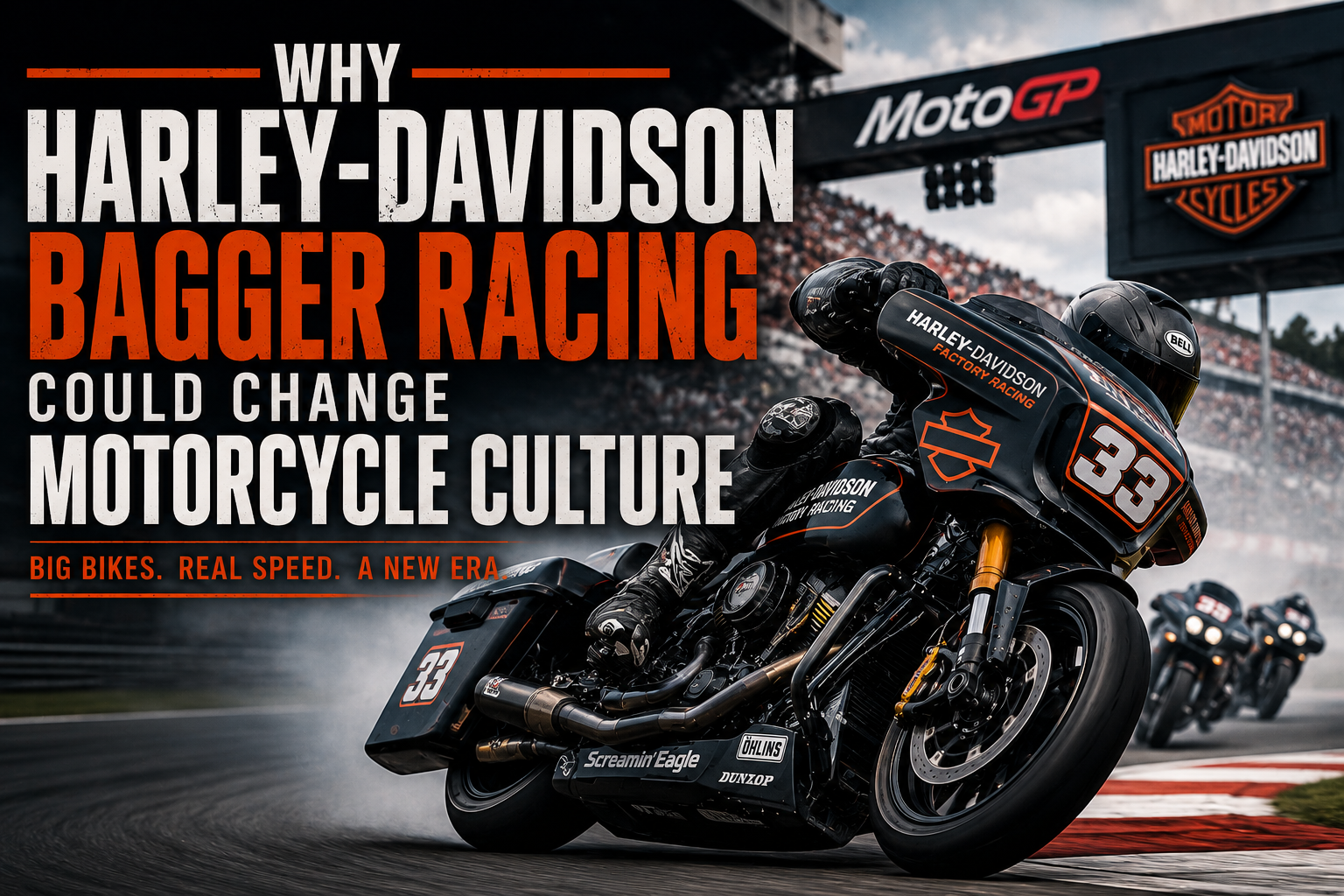
Bagger racing has evolved rapidly in recent years, transforming large touring motorcycles into high-performance race bikes.
These machines — often based on models like the Road Glide — are heavily modified for competition, featuring:
Upgraded suspension and braking systems
Performance-tuned engines
Lightweight components replacing traditional touring parts
What was once seen as an unlikely concept has become a legitimate racing category, attracting both fans and manufacturers.
Enter the Global Stage
The introduction of a dedicated Harley-Davidson racing series tied to international events has brought bagger racing into a much larger spotlight.
By aligning with global racing platforms, including events surrounding MotoGP weekends, Harley-Davidson is positioning bagger racing as more than a niche spectacle (Source: MotoGP.com).
This exposure is key.
Instead of existing on the fringes of the motorcycle world, bagger racing is now being presented to a global audience — many of whom may never have associated Harley-Davidson with performance riding.
Changing Perceptions of Performance
For decades, performance motorcycling has been dominated by sport bikes and lightweight machines.
Bagger racing challenges that idea.
Watching large, heavyweight V-twins lean aggressively into corners and compete at high speeds reshapes expectations of what these motorcycles can do.
It also introduces a different kind of performance — one that blends power, torque, and presence rather than pure speed and agility.
A Strategic Shift for Harley-Davidson
This move aligns with Harley-Davidson’s broader strategy to evolve its brand and reach new audiences.
As the company explores more accessible motorcycles and modern design approaches, racing provides a way to redefine its identity (Source: industry reporting and MotoGP coverage).
Instead of being seen purely as a heritage brand, Harley-Davidson is positioning itself within contemporary performance culture.
The Cultural Impact
Beyond racing, the impact is cultural.
Bagger racing sits at the intersection of:
Traditional cruiser culture
Performance riding
Modern customization
It brings together different segments of the motorcycle world — and in doing so, creates something new.
This could influence:
How riders build their bikes
How brands design future models
How younger riders view Harley-Davidson
Why This Matters Now
Timing is critical.
Motorcycle culture is already shifting:
Toward more diverse riding styles
Toward urban and lifestyle integration
Toward new visual and performance trends
Bagger racing fits directly into this evolution, offering a bridge between old and new.
Evolution, Not Replacement
It’s unlikely that bagger racing will replace traditional forms of motorcycling.
But it doesn’t need to.
Instead, it expands the definition of what Harley-Davidson — and cruiser culture — can be.
Final Thoughts
Bagger racing may have started as a niche idea, but it’s quickly becoming something much bigger.
By bringing these machines into a competitive, global environment, Harley-Davidson is doing more than entering racing — it’s reshaping how its motorcycles are perceived.
And in a culture that’s already evolving, that shift could have lasting impact.
Sources
MotoGP — event context and racing integration
Industry coverage of Harley-Davidson racing initiatives